viernes, 25 de julio de 2008

It's not where you are, it's where you go

espinas
Do negative events affect us as much as we think they do?
Human resilience is really quite astonishing. People are not the fragile flowers that a century of psychologists have made us out to be. People who suffer real tragedy and trauma typically recover more quickly than they expect to and often return to their original level of happiness, or something close to it. That’s the good news—we are a hardy species, even though we don’t know this about ourselves. The bad news is that the good things that happen to us don’t feel as good or last as long as we think they will. So all that wonderful stuff we’re aiming for—winning the lottery, getting promoted, whatever we think will change our lives—probably won’t do it after all. We’re resilient in both directions. We rebound from distress but we also rebound from joy.

(...) Happiness is the gauge the mind uses to know if it’s doing what’s right. When I say what’s right, I mean in the evolutionary sense, not in the moral sense. Nature could have wired you up with knowing 10,000 rules about how to mate, when to eat, where to seek shelter and safety. Or it could simply have wired you with one prime directive: Be happy. You’ve got a needle that can go from happy to unhappy, and your job in life is to get it as close to H as possible. As you’re walking through woods, when that needle starts going towards U, for unhappy, turn around, do something else, see if you can get it to go toward H. As it turns out, all the things that push the needle toward H —salt, fat, sugar, sex, warmth, security— are just the things you need to survive. I think of happiness as a kind of fitness-o-meter. It’s the way the organism is constantly updated about whether its behavior is in support of, or opposition to, its own evolutionary fitness.


http://www.pantherhouse.com/newshelton/happiness-is-just-around-the-bend-2-2/

viernes, 18 de julio de 2008

Why did you come last night, you hardly like me

60s
So, as an example, in the REM dream, is the fired-up amygdala causing the high emotional content, or is the mind -- freed from sensory constraints and thus prone to rushing into narrative extremes -- is the mind the real driver and we’re only seeing that emotional activity reflected in an agitated amygdala? That may sound like a heinously boring question, but experientially it actually makes for high adventure. Plus it gets into the whole deep mystery of existence thing.

(...) As far as our misconceptions about sleep, I would say the biggest one is this idea that we lose consciousness when the lights go out. This couldn’t be further from the truth. At night consciousness just turns inside out. Instead of moving through a world constructed from sensory input, we move through a world constructed from memory and imagination. We do lose certain self-reflective properties, and -- critically -- our short-term memories are compromised so we don’t remember many of our experiences. But when you wake people up in the night most of them report some kind of mental activity -- either the strange snap-shot narratives of sleep onset, the fully immersive dreams of REM, or the low-level “mentation” of deep sleep. Even in the emptiest bliss-saturated realms of slow wave sleep the experiencing self remains. Consciousness is 24-hours.

(...) Our minds are the only first-order event we know; everything else -- even other people’s reports of their mental experience -- is secondary. So it always at least starts from your own experience. Plus, if your subject is the mind -- and not just behavioral or brain activity -- then you have to rely on first-person reports. There’s no other way. The question is how to do it rigorously.


http://www.bookslut.com/features/2008_06_012943.php

jueves, 3 de julio de 2008

I just wanna be your lover

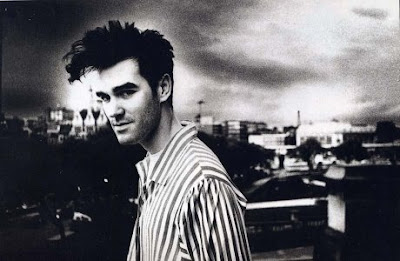
mozz
As I get older the adoration increases. I'm never without him… It's like carrying your rosary around with you". Wilde is, as Morrissey suggests, not only a literary figure but also an attitude, a stance, a sexuality even. Wilde represents isolation within one's own world and at the same time a very grand set of theories about the most irrelevant or absurd things. Similarly, Morrissey says that, "Going into Ryman's [the stationer's] is the most extreme sexual experience one could have". Elements of his pithier statements obviously reflect the Wilde notion of the extreme and improbable aphorism that sets one apart from one's contemporaries and establishes one as something of a bohemian. Some of the more notable examples from interviews have been, "I think a sex symbol is possibly the best thing to be", "If you've got a grain of intellect you run the risk of making your critics seem dull. So people feel the need to adopt the most violent attitude, even when they like you", "I would never, ever do anything as vulgar as having fun". As in the case of Wilde, this catalogue of amusing statements that amount to nothing in particular except self- promotion can be and is compiled frequently into pretty little books of quotations to be read while doing one's teeth or washing the dog.


http://www.bibliomania.com/0/22/336/1917/25744/1/frameset.html